


As part of my research into the book I’m writing, Undercraft: The Creative Practice of The Waking Dream, I’ve been connecting with thinkers and creators on Substack and asking them about both their craft and their peculiar experience of creativity.
Many imaginative people - writers, painters, musicians, filmmakers, etc. - drop into creative trances, like waking dreams, that deepen, intensify, and broaden their insight and inspiration. Examples include filmmaker David Lynch’s practice of transcendental meditation, painter Hilma af Klint’s experiences channeling others during seances, and Carl Jung's use of “active imagination” to generate spontaneous material for his Red Book. You can read more about what I’m planning to write about when my Substack fully launches here.
With all this in mind, I began subscribing to The Living Dark and reading books by Matt Cardin beginning with A Course On Demonic Creativity (which you can read for free by following the link). He kindly agreed to let me interview him.
Matt Cardin is an American writer, editor, and educator whose work explores the intersection of horror, religion, consciousness, creativity, and philosophy. He is the author of the horror collection To Rouse Leviathan and Writing at the Wellspring, a guide to creativity and the inner sources of artistic inspiration. A former professor of English and religion and current college vice chancellor of academic affairs, Cardin publishes The Living Dark, a Substack devoted to creativity, the daemon muse, spirituality, the weird, and the cultural challenges of modern life.
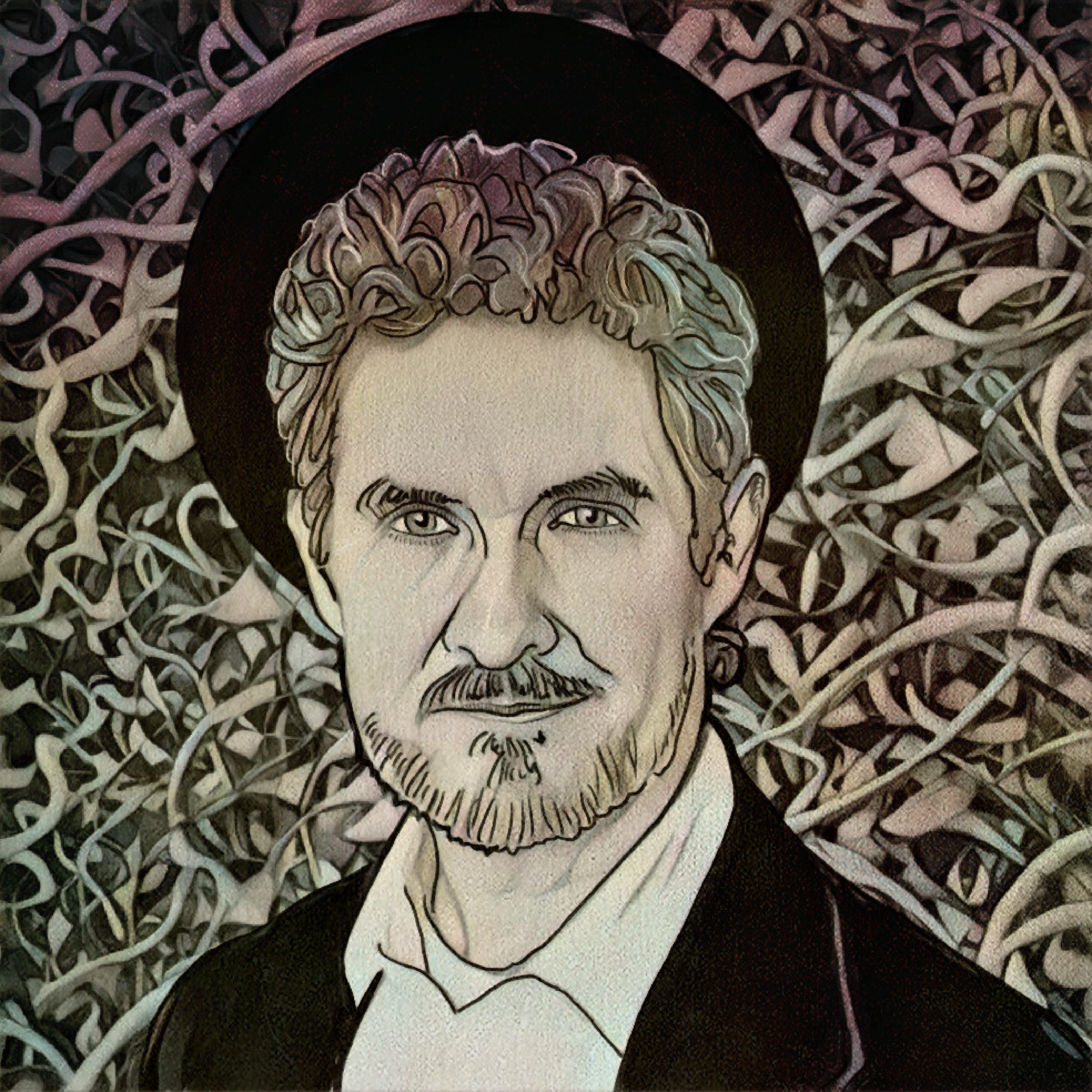
For Cardin, the “daemon muse” is neither a psychological metaphor nor a literal supernatural being. He sees creativity as a collaboration with an intelligence that feels genuinely “other” than the conscious ego. Artists don’t so much invent their deepest work as they allow creativity to emerge through an ongoing relationship with this inner source. So, a creator’s task is not to manufacture originality, but to cultivate receptivity, discipline, and attentiveness so that the daemon can speak through them. The daemon thus functions as both a creative partner and a guide, revealing themes and purposes that often exceed conscious intention.
SH: Many of my readers are writers, filmmakers, artists, and poets working in the horror genre. You’ve suggested that horror reveals what is true rather than what is merely frightening. What kinds of deeper truths does horror disclose?
MC: One way to get at the truth that horror discloses is to begin with the fact that horror is not just a literary and artistic mode but a primal response. As Douglas E. Winter famously insisted some decades ago, horror is not really a genre but an emotion. Whether or not we follow him all the way, I think we would do well to pay attention to what this response involves. What, exactly, is horror?
The first thing to notice is that horror isn’t just fear. It involves something additional, some element of recoil or disgust, not just the feeling of being scared but the feeling of having your skin crawl and your gut churn, accompanied by a desperate desire to get away. The formula might be “horror = fear + revulsion.” Importantly, the revulsion can be physical, moral, aesthetic, psychological, or even metaphysical—or all of these at once. When you’re struck with horror, you have the sickening sense that “this should not be.” You’re simultaneously repulsed and afraid. And also, sometimes, fascinated.
That fascination is where horror links up with the famous “sublime” of Romantic art and literary theory. The question that naturally arises is: Why should we be drawn to what frightens and repulses us? What kind of weird response is this, and what kind of weird creatures are we that find it built into us?
I’ll start bringing this admittedly meandering response to a point. On the nondual view that informs my thinking, each of us, as an apparently separate being, constitutes a little cosmos, a world unto ourselves. You’ve never known anything but your own world, nor have I ever known anything but mine. Nor could either of us ever know anything else. This world is organized around a sense of separation between me and everything else. “I” seem to inhabit, and to be enclosed within and confronted by, “the world.”
But this is actually a set of assumptions layered over our primary reality by cultural conditioning. What we call “I” and “world” are mental projections—or, perhaps more precisely, psychological constructions by which we differentiate among aspects of the totally enveloping theater of experience, whose earliest phases reach back to the moment of birth, and even further, into the womb. Reality itself is far bigger than, and different from, the virtual version of me-plus-world that we project during most of our waking hours—and that, as you may have noticed, loosens or breaks down when we’re asleep.
This means we sometimes encounter things coming at us from “the world” that our assumptions and projections don’t encompass: things we can’t process or understand, things that elude our philosophical net. These might be physical threats, personal losses, terrible accidents, paranormal phenomena, or any other event, object, or condition that our map of reality cannot contain. You might say the outer skin of our world is punctured by something from beyond it. The anomaly therefore presents itself as an awful threat—which is to say, as something that should not be.
Remember Lovecraft’s famous definition of cosmic horror in his grand essay Supernatural Horror in Literature? He described the proper attitude as one of “awed listening, as if for the beating of black wings or the scratching of outside shapes and entities on the known universe’s utmost rim.” For me, this has become a kind of master metaphor.
At the deepest level, in my view, all horror is cosmic horror. It’s made possible by our sense that we are separate beings in a universe where we can be threatened because our identity—the thing we take ourselves to be—has a boundary that can be punctured, whether this means a blade or monstrous talons puncturing our skin or some anomalous manifestation puncturing the shell of our mind. Horror happens when our personal cosmos is invaded by something from beyond it.
So what deeper truth does horror reveal? It reveals that we create the very conditions for feeling horror by taking ourselves to be limited identities in a world we didn’t make. And more: The thing that horrifies us is, in this sense, nothing but ourselves—the wider aspect of what we are, the totality of being, even Being itself—presenting itself to itself as something other and threatening. This also helps account for the fascination we feel.
Horror can therefore become a way of awakening to what we really are, if we can accept its offer, which we hardly ever do, precisely because it is so horrifying. It’s a strange and harrowing game we play with ourselves.
SH: One of the central observations of my practice of “Undercraft” is that the figures I encounter feel entirely autonomous. Do you think the objects, environments, and entities of the imagination are invented or discovered? Or, put another way, does it matter if the daemon is “real?”
MC: It doesn’t matter if imaginal figures really are separate, independent, autonomous beings possessing their own intelligence and will. What matters is that they feel and seem like this to us in the moment of encountering them. How could we ever know the truth of it? What would “the truth of it” even mean when we can’t see around our own corners? As I said, we’re all inextricably ensconced within our own theater of experience. We can’t step outside it to gain an objective view. What feels real is real, in a very real sense.
About the best we can do intellectually is to keep imaginal matters, including the experience of the muse and the daemon, deliberately in a liminal hyperspace by refusing to assign a truth value to them. Are they “really real”? Or are they just metaphors for unconscious processes? What do we even mean by “the unconscious”—a term that we’re too facile in throwing around without having recognized that we don’t know what the hell we mean by it?
Our best gambit, and our only really honest response, is to act as if these things are objectively real while holding tenaciously to the recognition that they might not be. I have found a vein of power in this dual attitude, which keeps minds and possibilities open instead of closing them with impossibly certain answers.
SH: How has Dean Wesley Smith’s concept of “Writing into the Dark” informed your own writing practice? Why is it important for writers to resist planning and outlining things beforehand, and face what is “unstable and unknowable, not available to perception, cognition, or direct awareness?” Why might this be particularly important for horror writers?
MC: I’ll start by pointing out that if someone wants to write an outline before drafting, they should definitely do it. The distinction between “planners” and “pantsers” among writers is a venerable one for a reason. Some people like to plan; others don’t. Some people’s creativity thrives on the former and some on the latter. Moreover, some of us find that we need to take different approaches to different projects. So I would never make the absolute assertion that no writer should plan or outline beforehand.
That said, Smith’s model of writing into the dark can be enormously valuable, and I recommend his book of that title to anyone and everyone. His deepest point is that we have basically two minds—or, in his vocabulary, two voices—as writers: the creative voice and the critical voice. What he calls the creative voice overlaps substantially with what I call the unconscious or daemon muse, but they’re not identical concepts.
As we can see from our own experience, along with the record of human history, our deep creative mind is primally imprinted with the patterns of narrative and storytelling. This is true whether we’re acting as writers or as readers and viewers, and it comes out in works of both fiction and nonfiction, and everything in between.
If we’ve learned through practice to get in sync with the creative mind, so that our conscious mind serves as a channel or conduit for it, we can simply start writing without a plan, proceeding from nothing but an idea, and allow the writing to form itself into patterns. Once those patterns become visible, the conscious mind can notice them without trying to seize control. We can then return to another round of writing and allow the creative mind to unfold them more fully. Eventually, we have a book, story, essay, poem, play, or screenplay, almost as if by magic.
Pressing too hard with the conscious critical mind—and, more than that, trying to make it serve as the source of the writing—represents a confusion of inner roles. This is what can happen if we become too locked into advance planning. But again, some people’s creative process thrives on planning. For whatever reason, their creative and conscious-critical minds have developed a fruitful way of working together through it. We should each figure out what works for us as the unique writers we are, and go all in on that.
For horror writers, writing into the dark may be especially valuable because horror depends so heavily on the arrival of what the conscious mind can’t domesticate in advance, all those images and presences that surprise even the writer. If you know too completely what’s waiting in the darkness, you may sap the story’s spirit.
“Practically speaking, the most basic statement of truth about writing and creativity in relation to the inner genius is this: You are not ultimately responsible for it. You are responsible for practicing the craft side of it so that you can forge yourself into a channel, an instrument, a conduit for its clear and truthful expression.” (p. 57 Writing At The Wellspring by Matt Cardin)
SH: One of the things I look for in a creative practice is an encounter with an “other” that pushes back against my assumptions, beliefs, and goals. Does your concept of a muse/daemon provide this kind of generative friction?
MC: Yes, indeed, and exactly. The concept and lived experience of the muse, daimon, daemon, or inner genius takes me beyond myself. I can get pretty charged up just by contemplating it or reading about it. I have also gotten great creative exhilaration out of writing two books and many blog posts and essays on it.
The daemon isn’t just a source of inspiration. It can push back against the ego’s assumptions with demands of its own. Also, adopting the attitude that your creative process is an inner collaboration with a spirit that’s somehow separate from you and yet somehow also your own higher self doesn’t mean you don’t need or won’t benefit from more conventional encounters with people in the outside world who can give you necessary pushback and perspective. But it does mean that you don’t bear the egoic weight of the entire process alone at its deepest level. It introduces an element of self-transcendence into the whole thing.
SH: The idea of a personal muse/daemon suggests that creative people are not originators of what they create, so much as conduits, translating and transcribing patterns originating elsewhere. What are some of the advantages of looking at creativity this way?
MC: Though I accidentally anticipated this question in my answer directly above, I’ll expand on it by saying that removing from the ego the pressure to create—which is not its function—opens a whole new source of creative power. The ego and its accompanying intellectual mind can deal only in what they already know. Their whole substance consists of established memories and patterns. They’re great at working with what they already have, but they can’t manufacture anything genuinely new. Another way of putting it is that the egoic mind, on its own, is condemned to recreate the past in some form. (As I say this, I’m put in mind for some reason of the glut of sequels from thoroughly played-out franchises that has dominated movie screens for more than a decade.) But the ego does have its own well-defined job, and the daemon muse model clarifies what that job is: to receive and refine what comes from beyond it.
Novelty has to come from beyond the ego, either from the world outside or from the beyond within. The daemon muse represents our point of contact with that beyond within. Plato’s Myth of Er describes each soul as choosing a life before birth and then being accompanied into that life by a daimon charged with guarding the choice. James Hillman’s later “acorn theory” transforms this into the idea that each of us enters the world with a daimon carrying the image of the distinctive character and calling we’re born to embody and play out. I find this both fascinating and energizing to contemplate, even as a metaphor. In this picture, our deepest uniqueness, emblematized by a spirit that accompanies us into life, is also our ongoing point of contact with the divine realm and its power.
If you bring something like this to your creative practice—again, feeling free to take it as a psychological metaphor or however else you want to take it, all the way to ceremonial magick and the quest for Knowledge and Conversation with your Holy Guardian Angel as a means of discovering and enacting your True Will, if that’s your jam—then you light everything up with possibilities unavailable to you if you simply grind away at your writing through sheer force of conscious will. You also relieve the dread you might otherwise feel under the pressure of taking sole personal credit or blame for what you write. It’s really a nice package. It also happens to refer to something true—or at least “true.”
SH: My practice of “Undercraft” mirrors Jungian “active imagination,” involves the cultivation of “waking dreams,” and often includes direct conversations with “others” in the psyche. In your experience, what are some ways that creative people can develop productive relationships and collaborations with their daemon?
MC: I love each of the practices you’ve described, and I have experimented with them all myself, especially the latter technique of conducting conversations with others in the psyche. I recommend them all.
I also strongly recommend experimenting with morning writing, such as Julia Cameron’s famous practice of “morning pages” as laid out in The Artist’s Way. You can also get to the same place through Natalie Goldberg’s Zen-inflected “writing practice” as most famously presented in her classic book Writing Down the Bones. Brenda Ueland’s equally classic If You Want to Write likewise takes you there.
Even above these, I might recommend Dorothea Brande’s classic (am I using the word classic too much?) Becoming a Writer for its recommendations on adopting the attitude that you are a double or triple personality in which creativity represents an inner collaborative division of roles, along with Ms. Brande’s specific advice—which is still utterly fresh nearly a century after she first offered it—on practical ways to cultivate this.
To plumb your daemon’s depths, consider using Ray Bradbury’s list-making exercise. Come up with a list of what I like to think of as “power nouns,” words that refer to things in your life—objects, places, people—that carry a personal mythic resonance for you. Bradbury’s list was full of things that his readers can recognize from his most beloved stories: the ravine, the skeleton, the lake, the carnival, and so on. After you make your list, pick an item from it and explain to yourself, passionately, on paper, what it means to you. From there you just may fall into writing a story or prose poem or who knows what else, all of it arising from your daemonic passion as focused through the lens of this particular word that took on a unique and potent meaning for you because of its place in your life.
I might also recommend personifying not just your creative spirit but its opposite. Maybe the best voice on this matter is Steven Pressfield with his presentation of Resistance—note the capital “R”—in The War of Art. All our creative attempts, he says, and even our creative ideas, are automatically accompanied by what seems for all the world like a monstrous spirit whose sole purpose is to murder them. He goes into detail, with much shrewdness and wit, about how to recognize this demonic anti-muse, and how to recognize its insidious trick of masquerading as the voice of your own better judgment. I can’t recommend his book enough.
I’ll also point out that I talk about this at some length in Writing at the Wellspring and add what I consider to be something fundamental to the idea of Resistance, what it means, and how to overcome it.
“The experience of the daemon or muse is essentially dissociative. It’s one part of the psyche, the ego, experiencing another part as separate or different, as an autonomous presence or intelligence with which the ego ‘I’ interacts.” (p. 71 Writing At The Wellspring by Matt Cardin )
SH: Creativity, in your view, is not something we consciously will; rather, we create the conditions for creativity to emerge all on its own. What are some things you do to create conditions that make it more likely your daemon will appear?
MC: I try to maintain an attitude of constant listening. I mean interiorly, although consciously searching for the quiet beneath auditory noise is also helpful. I have meditated off and on for decades, and this has helped me recognize the workings of my verbal and imaginal mind. It has also taught me to watch those workings and sometimes record what they’re doing.
Whenever I remember to do it, I also maintain an awareness of and receptivity to synchronicities in the outer world. I’ve found that when a creative idea with a strong, living charge is brewing inside me, strange synchronicities seem more likely to crop up in ordinary events. Sometimes an outer alignment of this kind, instead of an inner flash of inspiration, can serve as my notice that something is underway.
I also agree with the intelligent advice, which has become common in some online writing circles, about cultivating relationships, reading broadly, and doing other things that enlarge the surface area of potential serendipity. My daemon often seems to speak through such things.
I maintain a dedicated practice of early-morning reading, along with early-morning writing, and I let my interest have its head. More often than not, this keeps my enthusiasm for the things that interest me fresh, which in turn seems to feed my daemon muse.
I have also experimented with bibliomancy from time to time. A few months ago, I published a whole Living Dark series chronicling a seven-day experiment in bibliomancy. Using your bookshelf as a readily available oracle can be quite effective if you’re the type of person for whom such things feel meaningful. So can consulting more traditional oracles such as the I Ching.
SH: Lastly, there is an intensely spiritual side to your understanding of creativity. You suggest that the illusory ego is responsible for most of the blocks, resistance, and anxiety associated with creative work. I know this is a big subject, but can you talk about why concepts like non-duality can potentially free up the creative process?
MC: This spirals right back to my long answer to your first question about horror. Nonduality, at least as I have come to understand and experience it, is about recognizing that your sense of what you are is not what you actually are, and that “the world” is likewise fundamentally dreamlike in some respect.
The dividing line you draw—the outline you trace, as conditioned by culture, environment, and the inbuilt shape of the psyche—to separate “I” from “world” is an arbitrary division within a seamless total field of . . . something. We can’t really say what that something is, but it’s Reality, Being, whatever that really and truly means. “We,” as apparently separate egos, can never know it, even though we’re nothing but it. Hence the familiar analogies of waves or whirlpools in the ocean, recognizable differentiations that are ultimately nothing but water.
So how does this potentially free up the creative process? If the spirit of it really grips you, not just as a concept but as a living recognition, then you realize that your own life and identity are nothing more or less than a story being told by reality. Anything you write or otherwise create is effectively a subplot.
For me, something about this realization, combined with the daemon-muse model, has proved enormously invigorating. The apparent otherness of the daemon doesn’t contradict the nondual picture. It’s one of the ways the whole speaks to itself.
For one thing, the relief of the nondual recognition—“My lousy, limited mortal life isn’t actually what it seems to be”—is a great comfort. For another, it makes creativity the name of the entire game, including at the very base of what, on a mundane, workaday level, I still regard and experience as “Matt.”
It all comes together in an understanding, and more pertinently an experience, of creative flow that happens when it happens and doesn’t when it doesn’t. The stakes are comfortably low because none of it really matters, since everything is actually somehow fine. But this very fact tends to incite a feeling of energetic playfulness, like “Why the hell not? Why shouldn’t I pour myself wholeheartedly into this idea that has grabbed me, and try to write the hell out of it?”
And then of course that folds back to a felt sense of ever-present permission just to drop the whole thing if it comes to seem too much of a burden, and also to pick it up again.
This may have turned into a deeply idiosyncratic answer whose point of contact with you and your readers is obscure, but it’s my honest one.
*
Thanks again to Matt Cardin of The Living Dark!
If you have an established creative practice and this discussion of daemons, waking dreams, and the imaginal resonates with you, I’d love to hear more about your experience and practice. Reach out to me, Sean Hood, in the comments or by direct message. Perhaps I’ll end up interviewing you as well!
Wow Sean, this article is so, SO full of quotable quotes! I’m going to a) immediately subscribe to Matt Cardin, b) buy a copy of Writing into the Dark, and c) PDF this interview so I can return to it over and over again! ❤️
I have saved this to return to, I'm sure, many times. What a rich discussion that takes the phenomena of creativity and the imagination seriously! There is so much in both the questions and answers that eloquently expresses the experience of writing, for me, at least - the relationship with other, the multiplicities of self. I'm also delighted to finally have the word 'bibliomancy' added to my vocabulary - I often use the bookshelf as creative oracle and never knew it was a 'thing'!